The GB Row Challenge is renowned as the “world’s toughest rowing race.” Covering 2,000 miles around the rugged and unpredictable coastline of Great Britain, it demands monumental physical strength, unwavering mental resilience, and masterful seamanship. Yet, beneath the surface of this ultimate endurance test lies a second, equally critical mission. In an innovative partnership with the University of Portsmouth, GB Row has transformed these elite racing shells into sophisticated, “floating laboratories.”
This blog explores the remarkable engineering and cutting-edge technology that allow a simple rowing boat to collect world-class oceanographic data. We will track how specialised sensors, strategically integrated into the vessel, gather vital information on microplastics, environmental DNA (eDNA), and underwater noise pollution, turning a race for glory into a race for data that can help protect our coastal waters.
The Power of “Citizen Science” at Sea
The concept of using non-scientific vessels to gather data, known as citizen science, is not new. Ferries and cargo ships have long been equipped with simple sensors to monitor sea surface temperature or salinity. However, GB Row takes this concept to a microscopic and acoustic level that is entirely unique.
The coastline of Great Britain is incredibly diverse, from the busy shipping lanes of the English Channel to the pristine, untouched waters of the Scottish Hebrides. Traditional research vessels, which are large, expensive, and require significant fuel, cannot navigate these shallow coastal areas frequently. A fleet of rowing boats, moving slowly and silently at eye level with the ocean, offers an unprecedented opportunity to map these waters in detail. They can sample the entire 2,000-mile perimeter continuously, creating a cohesive, high-resolution dataset that a single research ship could not achieve.
Anatomy of the Floating Lab: Sensor Integration
Converting a racing boat into an ocean sensor requires ingenious engineering. Every square inch of space on a 10-meter ocean rowing boat is already allocated to crew, freeze-dried food, and safety gear. The scientific equipment must be lightweight, durable, energy-efficient, and integrated so that it does not compromise the boat’s speed, balance, or safety.
Engineers from the University of Portsmouth and specialist marine tech firms work closely with boat builders to “hardwire” these labs. This integration begins at the construction phase and continues until race day.
The Power Challenge
Before discussing the sensors, it’s vital to understand how they are powered. These labs operate far from the grid. All scientific equipment, navigation systems, and satellite communications are powered entirely by renewable energy. Large, semi-flexible solar panels are bonded to the curved surfaces of the bow and stern cabins, charging a bank of lithium-ion batteries. Every watt is precious. The systems must be designed for exceptionally low power consumption, automatically duty-cycling or powering down when data collection is complete, to ensure the crew is never left without navigation power.
Sampling the Invisible: Microplastics
One of the primary goals of the GB Row scientific mission is to map microplastic pollution. Microplastics, defined as plastic particles smaller than 5mm, are pervasive throughout the marine environment, from the poles to the deepest ocean trenches. To understand their distribution around the UK, the boats use a specialised, low-power sampling system.
How the Microplastic Sensor Works
The system is elegant in its simplicity. An intake valve, protected by a fine mesh to prevent large debris from entering, is installed through the hull below the waterline. This intake is connected to a small, durable peristaltic pump. This pump, powered by the solar array, draws a continuous, measured stream of seawater through a series of increasingly fine stainless-steel filters housed inside the boat.
As the rowers move, this pump runs continuously, sampling hundreds of litres of water over each leg of the race. The water is filtered down to 50 microns (roughly the width of a human hair).
At designated points or “tidal gates” during the race, the crew must perform a critical lab task: they manually change the filters. The used, microplastic-laden filters are carefully sealed in sterile, contamination-free bags, labelled with the precise GPS coordinate, date, and time of the sampling period. These are stored on board until the boat returns to London, where they are handed over to the University of Portsmouth for forensic analysis using Micro-Raman spectroscopy to identify the type and quantity of plastic. This creates a detailed, 2,000-mile “heatmap” of plastic pollution around the UK.
Reading the “Genetic Fingerprint”: Environmental DNA (eDNA)
Perhaps the most revolutionary technology on board is the environmental DNA (eDNA) sampling system. Every living organism in the ocean constantly sheds genetic material into the water, through skin cells, mucous, metabolic waste, or reproductive material. By filtering and analysing this “biodiversity soup,” scientists can identify what species are present in an area without ever seeing or capturing them.
The On-Board eDNA Process
Collecting valid eDNA samples in the wild is notoriously difficult due to the high risk of contamination from the crew or the boat itself. The GB Row boats are equipped with a bespoke filtration unit developed in collaboration with NatureMetrics.
The process mirrors the microplastics sampling but requires extreme sterility:
- Sterile Intake: Seawater is drawn through a dedicated, sterile intake valve, separate from the microplastics system.
- High-Volume Filtration: The water is forced through a specialised, encapsulated eDNA filter disk. These filters have a pore size of just 0.2 microns, trapping genetic material from organisms ranging from microscopic bacteria and plankton up to large mammals like Harbour Porpoises and Minke Whales.
- Preservation: Once the filtration cycle is complete, the crew removes the filter capsule and injects it with a preservative solution. This instantly stabilises the captured DNA, preventing it from degrading during the weeks at sea.
- Data Logging: Like the microplastic samples, each eDNA filter is sealed and GPS-tagged. This process allows scientists to create a detailed map of marine biodiversity around Great Britain, tracking the presence of commercially important fish stocks, invasive species, and rare or endangered marine mammals.
- Listening to the Deep: Underwater Noise Pollution
The ocean is not silent. However, human activity is making it increasingly loud. Underwater noise pollution, from shipping, construction, and oil exploration, can have devastating effects on marine life, interfering with the echolocation and communication systems of whales, dolphins, and porpoises. To monitor this, the rowing boats are equipped to “listen.”
The Hydrophone Array
A hydrophone, which is a highly sensitive underwater microphone, is integrated into the boat’s rudder or hull. While standard research ships produce significant engine noise that can contaminate acoustic data, a rowing boat is essentially silent, providing an ideal, “quiet” platform for recording.
The hydrophone continuously records the ambient soundscape as the boat travels. This is not just a simple audio recording; the system is calibrated to measure specific sound pressure levels across a wide frequency range.
The on-board computer processes this data, analysing the frequency and intensity of sounds. This allows scientists to map different sources of noise pollution. They can distinguish the low-frequency drone of distant supertankers from the sharp clicks of echolocating cetaceans. By correlating these recordings with eDNA data, researchers can begin to understand how high levels of underwater noise may be displacing sensitive species from key habitats.
The 2,000-Mile Transsect: Data with a Purpose
The data collected by these floating labs is not theoretical; it is immediately useful and publicly accessible. GB Row’s scientific data is uploaded to The Marine Data Exchange, a platform managed by The Crown Estate. This ensures that environmental policymakers, conservation charities, and offshore developers have access to robust, independent data.
This slow, continuous 2,000-mile transsect provides a unique baseline against which future changes can be measured. It can help identify areas that are particularly stressed by pollution and guide the creation of more effective Marine Conservation Zones.
The 2026 GB Row Challenge teams are not just training their bodies; they are training to be lab technicians. They are the essential component that makes this entire system work. While battling 30-foot waves and 40-knot winds, they must also ensure that every eDNA filter is sterilised, every microplastic sample is sealed, and every acoustic recording is running.
By transforming a test of human endurance into a tool for environmental observation, GB Row is redefining what is possible in the world of citizen science. These boats may be small, but the data they carry is powerful, helping us to listen, look, and ultimately protect the vital coastal waters of Great Britain.
Share This Story, Choose Your Platform!
Recent Posts
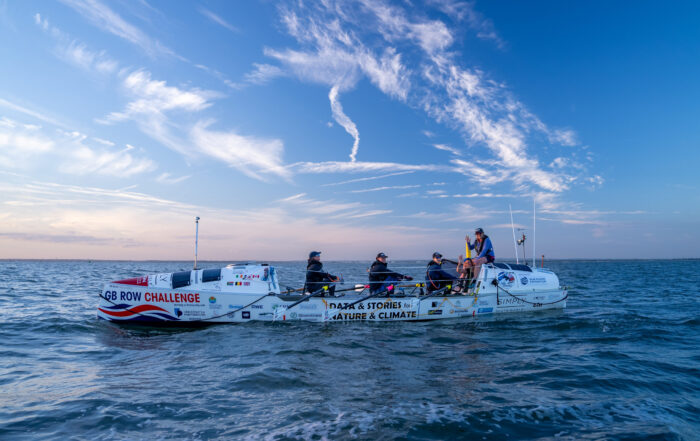
National survey finds microplastic pollution around Britain’s coastline could be double than previously recorded
Microplastic pollution in the seas around Great Britain has been found at significantly higher concentrations than previously recorded by a joint project between the University of Portsmouth and GB Row Challenge. Data collected during the [...]
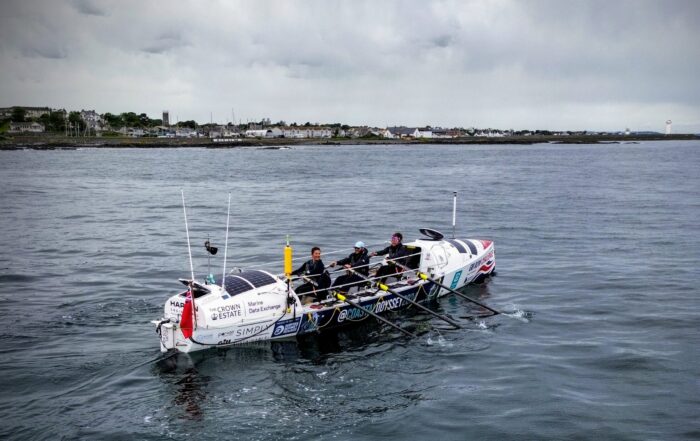
The Crown Estate joins GB Row Challenge as lead environmental data partner
The Crown Estate has partnered with GB Row Challenge, the endurance rowing race which collects vital scientific data on the health of UK coastal waters. GB Row Challenge, described as ‘the world’s toughest rowing race’, [...]