The GB Row Challenge is famously billed as the “world’s toughest rowing race.” It is a 2,000-mile unassisted circumnavigation of Great Britain that forces crews to contend with the UK’s most treacherous tidal gates, busy shipping lanes, and notoriously fickle weather. While the physical demands are obvious, any seasoned ocean rower will tell you that the race is not won in the gym. It is won in the six inches between your ears.
To prepare for the 2026 race, athletes must balance a rigorous physical regimen with deep psychological conditioning. Here is the breakdown of how to prepare for the “World’s Toughest” by balancing raw physicality with mental grit.
The Physical Pillar: Building the “Diesel Engine”
Rowing 2,000 miles is not a sprint; it is an ultra-endurance event that requires a body capable of performing under extreme fatigue for weeks on end. Training for this level of physicality focuses on three core areas:
Functional Strength and Injury Prevention
Unlike Olympic rowing, which is highly explosive, ocean rowing is about repetitive, low-impact power. Training must focus on:
- Leg and Posterior Chain Power: The power in a rowing stroke comes from the legs. Squats, deadlifts, and lunges are essential to build the “chassis” of the rower.
- Core Stability: A rowing boat is constantly moving. A rock-solid core prevents lower back injuries and allows for efficient power transfer through the oars even in heavy swells.
- Grip and Forearm Endurance: Holding an oar for 12 hours a day can lead to “boat bites” and tendonitis. Specific grip work and high-volume pulling exercises are vital.
The 2-on, 2-off Aerobic Base
The race operates on a relentless schedule: 2 hours of rowing followed by 2 hours of rest, 24 hours a day. Training must mimic this. “Steady state” sessions on the rowing machine (ergometer) lasting 90 to 120 minutes help build the mitochondrial density required to recover quickly between shifts.
The Mental Pillar: The “Mind Over Matter” Philosophy
If physicality gets you to the start line, mentality gets you to the finish. In the middle of the Irish Sea at 3 AM, with a headwind and a leaking cabin, your deadlift max becomes irrelevant.
Resilience Through Simulation
The best way to train the mind is to remove the “shock” of the environment. Teams must spend hundreds of hours on the water before the race begins. This includes night rowing and training in “sub-optimal” weather. By experiencing cold, wet, and dark conditions during training, the brain learns that these are manageable states rather than emergencies.
Conflict Resolution and Team Dynamics
You are trapped on a 10-metre boat with several other people, all of whom are sleep-deprived and hungry. Mental preparation involves:
- Establishing Communication Protocols: How will you speak to each other when things go wrong?
- Understanding “Low Points”: Recognising that everyone will have a “dark day” and learning how to support a teammate through it without taking their frustration personally.
The Technical Skill: Skill as a Mental Tool
In the GB Row Challenge, technical skill is a form of mental insurance. If you know exactly how to handle a fast-turning tide or navigate a complex shipping lane, you reduce the “cognitive load” on your brain.
- Navigation and Tides: Unlike trans-Atlantic rowing, where you often go with the flow, GB Row requires expert knowledge of the UK’s tidal stream. Mastering this during training reduces anxiety during the race.
- Boat Maintenance: Knowing how to fix a broken watermaker or a steering cable under pressure provides a sense of control. Control is the antidote to panic.
Physicality vs Mentality: Which Matters More?
While a baseline of fitness is non-negotiable, the consensus among GB Row veterans is a 30/70 split. 30% is your physical preparation, and 70% is your mental resilience.
A physically “weaker” team with iron-clad mental discipline and a unified crew spirit will almost always beat a team of high-performance athletes who lack the mental flexibility to handle the deprivation of life at sea.
Total Preparation: The 2026 Strategy
For the teams lining up at Tower Bridge in 2026, the final months of training should shift from building raw muscle to refining the “race brain.” This involves tapering physical loads to prevent burnout while increasing “darkness training” and team-bonding exercises.
Frequently Asked Questions
Do I need to be a professional rower to enter?
No. Many successful GB Row participants come from non-rowing backgrounds, such as endurance running, cycling, or the military. What matters is your ability to learn the technique and your underlying “engine.”
How do you handle sleep deprivation?
The “2-on, 2-off” system is brutal. In training, rowers practice “polyphasic sleep” to get their bodies used to 90-minute naps. Over time, the brain learns to enter REM sleep more quickly to compensate for the short windows.
What is the biggest mental challenge?
Most rowers agree that “The Boring Bits” are the hardest. When the weather is calm, but the tide is against you, and you aren’t moving, the lack of progress can be more soul-destroying than a massive storm.
How many calories do rowers burn?
A rower can burn between 5,000 and 8,000 calories per day. Physical training must include a “nutritional rehearsal” to ensure your stomach can handle that much freeze-dried food under stress.
Share This Story, Choose Your Platform!
Recent Posts
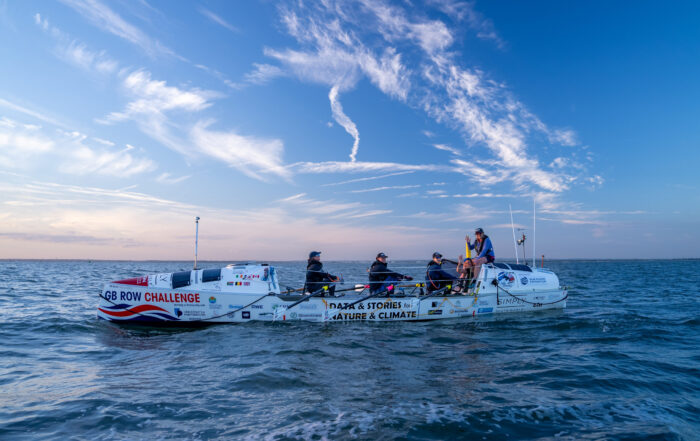
National survey finds microplastic pollution around Britain’s coastline could be double than previously recorded
Microplastic pollution in the seas around Great Britain has been found at significantly higher concentrations than previously recorded by a joint project between the University of Portsmouth and GB Row Challenge. Data collected during the [...]
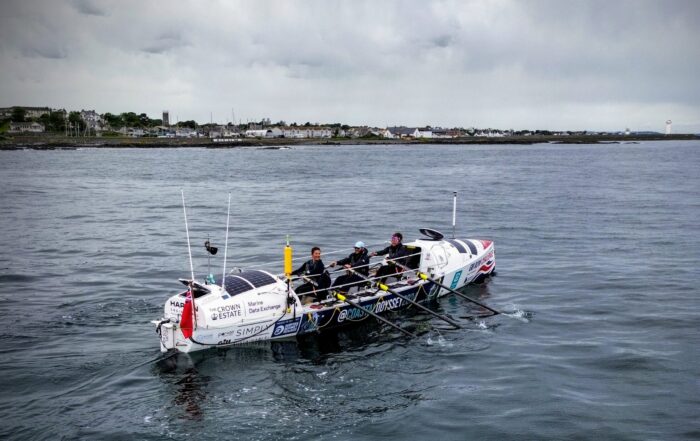
The Crown Estate joins GB Row Challenge as lead environmental data partner
The Crown Estate has partnered with GB Row Challenge, the endurance rowing race which collects vital scientific data on the health of UK coastal waters. GB Row Challenge, described as ‘the world’s toughest rowing race’, [...]