Patrick Deacon had never rowed before skippering a crew that completed the GB Row Challenge in 2024. His team ‘Coastal Odyssey’ set a new Guinness World Record for the fastest mixed team of six to row continuously and unsupported around Great Britain in 49 days, one hour and 29 minutes.
I skippered a crew that completed the GB Row Challenge, and what I learned is this: you don’t train for the challenge by replicating it. You train so your body – and your team – can survive the onslaught of having to row 12 hours a day without getting injured.
The first misconception is that you prepare by rowing all day, every day. You don’t. If you tried to row 12 hours a day in training, you’d break your body long before you reached the start line.
Training begins with mastering technique, often on an indoor erg, focusing on quality over quantity. From there, volume is gradually increased to build endurance, followed by a focus on power and intensity. Throughout it all, injury prevention is key, with strength training used not to build size, but to make the body resilient enough to withstand the relentless demands of ocean rowing.
Starting from zero
Sometimes it surprises people that I’d never done any rowing before. I’d never been on an erg, never rowed on the water. I joined a rowing club after committing to the challenge but flooding meant I only had one session on the river.
I was turning 40 and wanted to take on a big challenge. I’d considered an Atlantic crossing and I’d even booked an ultramarathon in Antarctica. But when I came across the GB Row Challenge, I felt excited by the coastline, the wildlife, and the sheer scale of the journey. I cancelled Antarctica. And that was that.
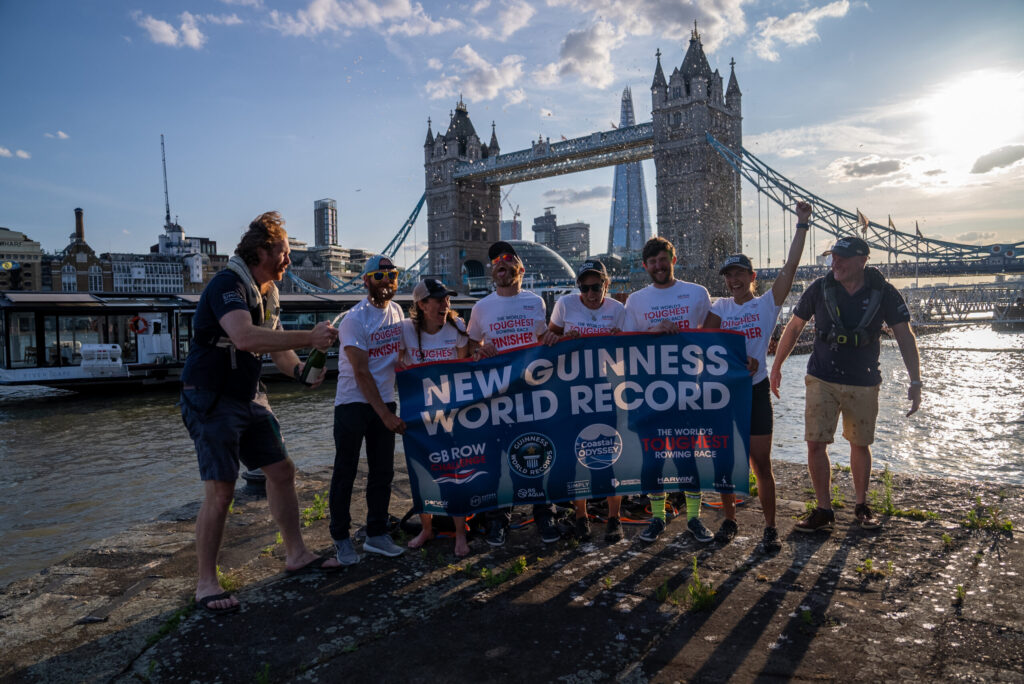
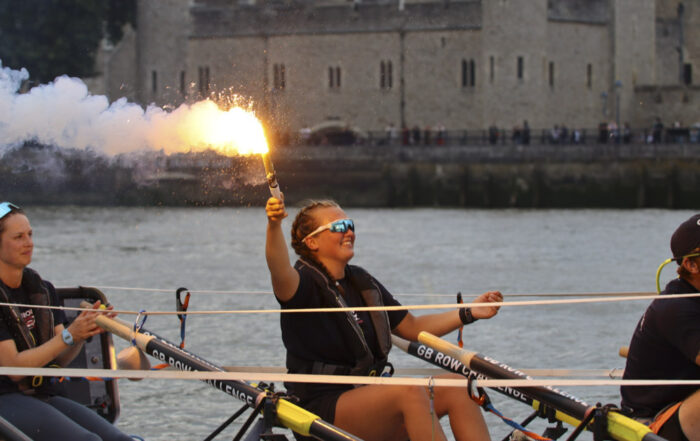
Coastal Odyssey celebrating after successfully circumnavigating Great Britain and setting a new Guinness World Record
Hidden challenges
Once you’ve got a team together, you have to align six people’s calendars, which is hard! Then you’ve got to hope the weather will allow you to get out on the water and train. We spent weeks turning up ready to train, only to be turned away by the conditions. At the time it was frustrating, but looking back it proved invaluable.
Those weekends became less about rowing and more about building the team, whether that was training together in the gym, sorting kit and food, working through qualifications, or even completing a marathon relay on an erg. That time off the water built a strong foundation of trust, and when you later find yourself living within three feet of each other for weeks on end, that trust matters more than anything.
Becoming skipper
Signing up to be skipper came later, when circumstances meant we had to look within the team rather than bring someone in externally. Taking on the role brought a significant amount of responsibility, along with a long list of qualifications to complete, including VHF radio, sea survival, first aid and medical training, navigation, Day Skipper theory and practical, and Yachtmaster theory.
What’s often described as 30-40 hours of study quickly became far more once exams, revision, and actually getting to grips with the material were factored in. It felt like a second job for a while. But in reality, skippering isn’t just about ticking off qualifications; it’s about making decisions when things become uncertain, which, out at sea, happens more often than you’d like.
Life on board
A typical day on board looks slightly different for each person, because although there are six of you, the workload is divided so no one is trying to do everything at once. That would be impossible, not least because you wouldn’t get any sleep.
Each crew member takes ownership of a specific role. One person manages food stocks and daily rations, another monitors water levels and battery power and decides when to make water. Someone else handles navigation and weather, including communication with the land-based safety team, while another is responsible for collecting the daily science samples.
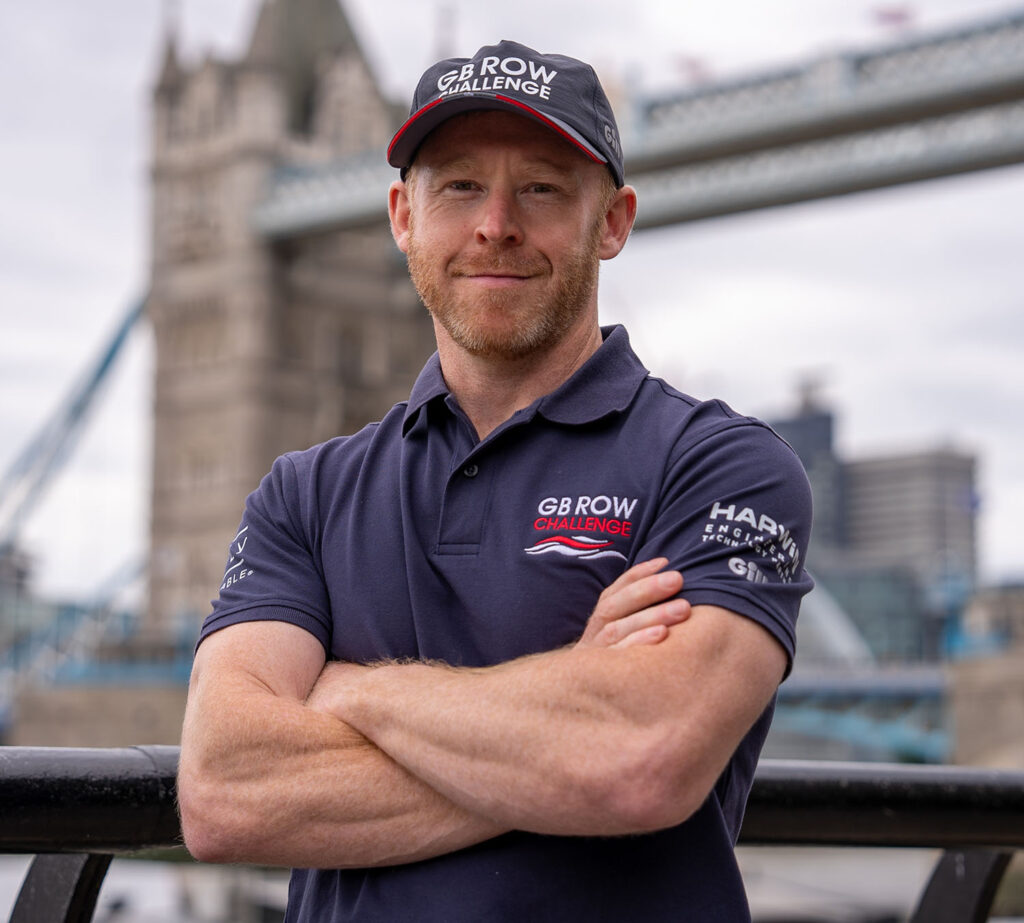
Patrick has now joined the team as Operations Director for GB Row Challenge
This all runs around a strict two hours on, two hours off rowing rotation, which in good conditions adds up to around 12 hours of rowing a day. The remaining time is spent eating, sleeping, washing and completing assigned tasks.
We initially split into two cabins and organised ourselves so there was always someone in each, helping to balance the boat and ensure key systems were being monitored. From there, we formed two teams of three, rotating every two hours. After the first week or so, we introduced a staggered crossover, with myself and the first mate offset by an hour. This meant we could spend time with both teams, rather than operating in completely separate groups.
The science
Another aspect I really loved about the GB Row Challenge was the combination of an epic endurance challenge with meaningful ocean conservation research. It added a completely different dimension to the experience.
As a team we were really invested in the wider scientific purpose and were methodical about collecting and storing the samples. Hats off to my crew mates Daisy and Lia who were mainly responsible for this, because collecting samples at sea could sometimes be challenging.
Daisy often had to gather eDNA samples from the back of the boat while feeling seasick. That might mean going from lying down in the cabin, climbing out through the hatch, collecting the sample while trying not to be sick, handling the syringe process, and then heading straight back down to recover. It was physically and mentally demanding, especially in rough conditions.
Lia, who was collecting microplastics, faced a different kind of challenge. Monitoring the flow rate required leaning into the cabin space, which, with the boat constantly moving, made it all too easy to knock your head or lose balance. In many ways, the actual collection process was harder than storing the samples, as it had to be done consistently and carefully in an environment that was anything but stable.
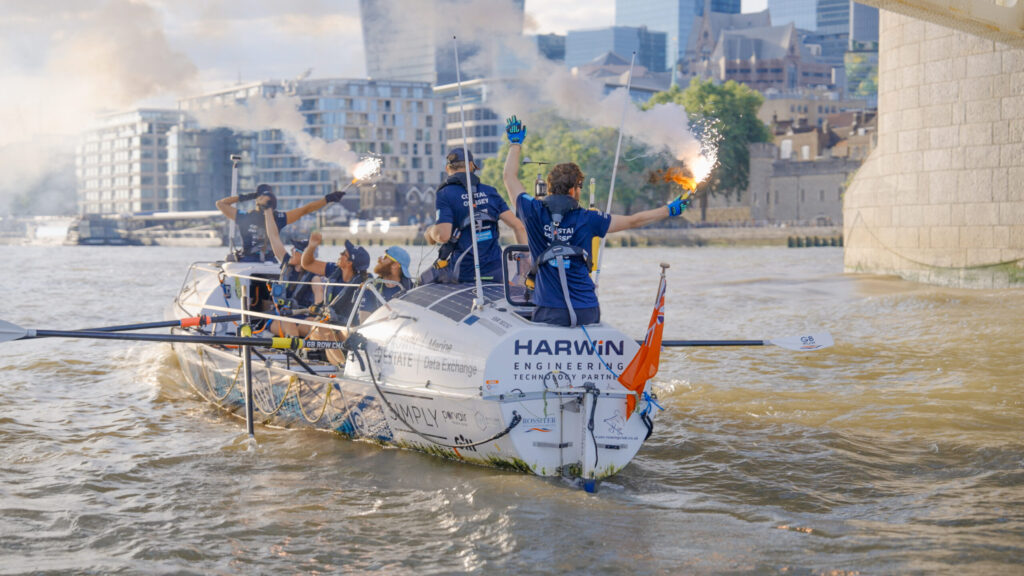
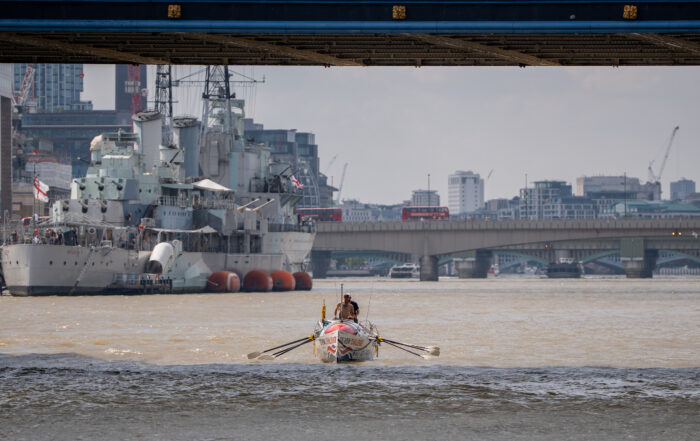
Coastal Odyssey head towards Tower Bridge after successfully circumnavigating Great Britain.
Despite the difficulties, it was motivating to know that we were collecting data which would contribute to real-world research on marine environments and wildlife. It really helped to keep us focused.
The data will be hosted on The Crown Estate’s Marine Data Exchange (MDE), one of the world’s largest collections of marine industry data, accessible to everyone around the globe. It’s quite humbling to think we have contributed to a dataset that can be used by scientists, policymakers, industry and the general public.
The finish line
Stepping back onto land is not just a feeling of relief, it is a sense of release. As skipper, the weight of responsibility lifts the moment everyone is safe, and only then do you begin to process what you have achieved.
The reality is that the challenge never feels guaranteed. At any moment, the weather can turn, equipment can fail or someone can get injured, and you are always just one decision away from ending the row.
Share This Story, Choose Your Platform!
Recent Posts
Youngest woman ever to row around Great Britain as team Nautilus sets new world record
The crew completed the unsupported 2,000-mile GB Row Challenge in record time while contributing to marine research 22-year-old Grace Church has become the youngest woman ever to row around the British mainland, after crossing the [...]
Five-man crew complete 2,000 mile row around Great Britain setting a new world record
Team Rowmads has successfully completed an extraordinary unsupported circumnavigation of Great Britain by rowing boat, covering approximately 2,000 miles in one of the world's most demanding endurance challenges. The team is the first and fastest [...]